The Living Mirror: How Digital Twins Are Hacking the Soil Microbiome
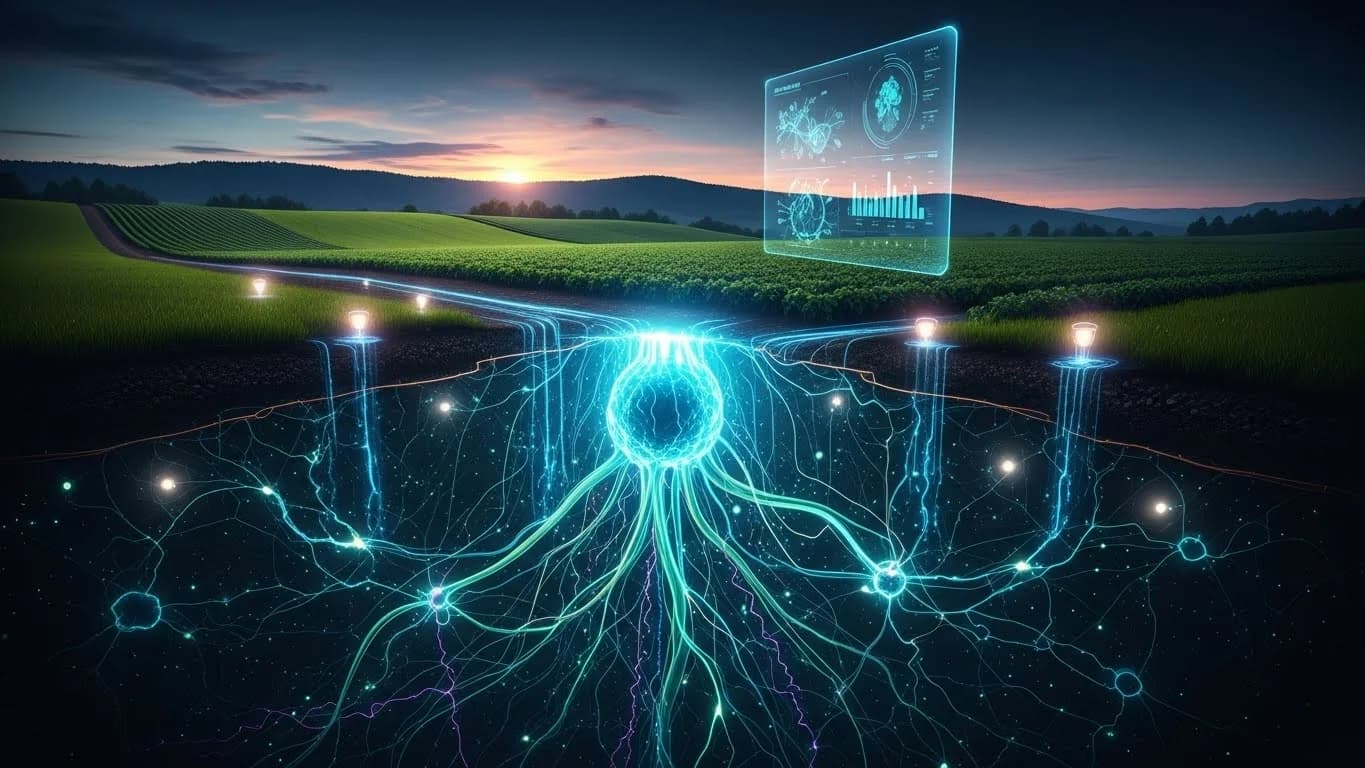
Table of Contents
- The Hard Fork: From Precision to Predictive
- The Nervous System: Moving Beyond the Lab
- The Brain: Generative AI and the Zero-Inflation Problem
- The Payoff: Predictive vs. Reactive Operations
- The Future is In-Silico
The Hard Fork: From Precision to Predictive
Agriculture is undergoing a hard fork. For the last thirty years, we have operated under the paradigm of Precision Agriculture—a discipline of spatial variability. We gridded fields, mapped yields, and optimized NPK inputs. It was efficient, but fundamentally reactive. We treated soil as a static chemical reservoir, ignoring the chaotic, living engine inside it.
Today, we are shifting toward Predictive Regenerative Farming, driven by a new architectural stack: the Soil Digital Twin (SDT). An SDT is not just a static 3D map; it is a dynamic, probabilistic simulation of the soil ecosystem that updates in real-time. By fusing hyper-local sensor data with generative AI, we are finally decrypting the "black box" of the soil microbiome.
The core insight is simple but profound: soil is not dirt. It is a living system with trillions of microbial actors engaged in constant metabolic negotiation—fixing nitrogen, decomposing organic matter, cycling nutrients, and signaling to plant roots. Traditional soil tests capture a snapshot of this system's outputs (pH, N-P-K levels) but miss the dynamics entirely. By the time a lab result arrives, the soil biology has already shifted.
The SDT changes this by creating a living mirror of the soil—a virtual environment that runs in parallel with the physical field, updated continuously by edge sensors and refined by machine learning models that understand microbial ecology.
Here is the architecture making this possible.
The Nervous System: Moving Beyond the Lab
The biggest bottleneck in legacy ag-tech was latency. Sending a soil core to a wet lab takes days; the soil biology changes in minutes. The SDT requires a nervous system that operates at the speed of the edge.
We are seeing a transition from discrete sampling to continuous, in-situ monitoring using novel form factors:
Smart Nails (RFID)
These are battery-free, passive sensors inspired by backscattering communications. Inserted into the soil profile, they modulate RF signals from a passing drone or tractor to transmit real-time moisture and microbial activity data without the failure points of underground wiring.
The physics is elegant: the sensor harvests energy from the incoming radio wave, uses that energy to flip transistor states encoding data, and reflects the modulated signal back to the reader. No battery means no maintenance window, no corrosion failure, and deployment densities previously impossible with active sensors.
Organic Electrochemical Transistors (OECTs)
Unlike rigid silicon sensors that foul easily in the soil matrix, OECTs use conductive polymers that are biocompatible and flexible. They provide high transconductance, effectively amplifying weak biological signals to detect nutrient ions (NO3-, K+, NH4+) in the soil solution with high temporal resolution.
The key advantage is that OECTs operate in aqueous environments—exactly where soil chemistry happens. Traditional ion-selective electrodes require calibration and suffer from drift. OECTs maintain stability over agricultural timescales (weeks to months) and can be manufactured at costs approaching pennies per unit, enabling farm-scale deployment.
Volatile Organic Compound (VOC) Sensing
Soil microbes "breathe." By monitoring the flux of CO2 and specific VOC cocktails, we can detect the olfactory signatures of stress—like denitrification (loss of nitrogen to atmosphere) or pathogen attack—before visible symptoms appear on the crop.
Different microbial processes produce characteristic VOC fingerprints:
- Geosmin and 2-MIB: Indicators of actinobacteria activity and healthy decomposition
- Dimethyl sulfide: Signals sulfur cycling and can indicate waterlogging stress
- Ethylene: A stress hormone that signals root damage or pathogen invasion
- Methane: Indicates anaerobic conditions and potential denitrification
This multi-modal sensor fusion creates a high-fidelity Sensor Fusion Matrix that feeds the digital twin with the continuous data stream it needs to maintain state coherence with the physical field.
The Brain: Generative AI and the Zero-Inflation Problem
The most complex component of the twin is the microbiome. A teaspoon of soil contains billions of organisms representing thousands of species, but traditional metagenomics datasets are sparse and zero-inflated—most species appear to be missing in any given sample.
This is not a measurement error; it is reality. Microbial communities are patchy at the centimeter scale. A sample from one location might show abundant Pseudomonas; a sample from ten centimeters away might show none. Standard regression models assume continuous, normally distributed data. When 90% of your species abundance matrix is zeros, these models fail catastrophically.
The GAN Architecture
To simulate this stochastic system, we are borrowing architecture from computer vision: Generative Adversarial Networks (GANs).
Models like MB-GAN (Microbiome GAN) use two competing neural networks—a Generator and a Discriminator:
-
The Generator takes random noise as input and produces synthetic microbial abundance profiles—essentially "hallucinating" what a soil microbiome might look like.
-
The Discriminator receives both real metagenomic data and the Generator's synthetic outputs, then tries to classify which is which.
Through this adversarial game, the Generator learns to produce increasingly realistic outputs. Critically, it learns not just the marginal distributions (how common each species is on average) but the latent correlation structures—which species co-occur, which are mutually exclusive, and how communities shift in response to environmental gradients.
Why GANs Outperform Traditional Models
Traditional imputation methods (mean imputation, k-nearest neighbors) assume the missing data is Missing at Random (MAR). In microbiome data, zeros are not random—they reflect real biological absence driven by niche partitioning, competitive exclusion, and environmental filtering.
GANs learn these biological constraints implicitly. The Discriminator penalizes the Generator for producing biologically implausible outputs—like generating high abundances of obligate anaerobes in well-aerated soil. The result is synthetic data that respects the underlying ecology.
Applications in the Digital Twin
This allows the Digital Twin to:
Impute Missing Data: Generate biologically realistic microbiome profiles for un-sampled areas of the field. If you have sensor data from 10 locations and need predictions for 1,000, the GAN-augmented model can fill the gaps without the artifacts that plague traditional interpolation.
Run "In-Silico" Trials: Simulate how the microbiome will shift under different management scenarios. "What happens to fungal networks if I switch to no-till next season?" "How will this cover crop cocktail shift my nitrogen-fixation capacity?" These questions can now be explored virtually before committing resources in the field.
Detect Anomalies: By learning what "normal" looks like, the model can flag when sensor readings suggest the real microbiome has diverged from expectations—an early warning system for disease pressure or nutrient stress.
The Payoff: Predictive vs. Reactive Operations
The ultimate goal of the SDT is to move agronomy from a reactive discipline (treating symptoms) to a predictive one (managing risk).
Predictive Pest and Disease Management
Companies like Pattern Ag and Biome Makers are already commercializing this predictive capability. By sequencing the soil DNA and feeding it through trained models, they can forecast pest pressure—like Corn Rootworm larvae density—with greater than 90% confidence up to 12 months before the crop is planted.
This temporal advantage is transformative. Traditional integrated pest management (IPM) is reactive: scout the field, find the pest, apply control. By the time damage is visible, yield loss has already occurred.
Predictive management inverts this timeline. If the model forecasts high rootworm pressure based on the current microbiome state, the farmer can make defensive decisions long before the tractor enters the field:
- Seed trait selection: Choose hybrids with Bt resistance traits
- Biological inoculants: Apply entomopathogenic nematodes or fungal biocontrol agents
- Rotation decisions: Switch to a non-host crop for that field
The economic value is not just in avoided damage—it is in optimized input allocation. Why apply expensive biological controls to fields where the model predicts low pressure? The SDT enables variable-rate decision-making at the microbiome level.
Digital MRV for Carbon Markets
Perhaps the most economically significant application is Digital MRV (Measurement, Reporting, and Verification) for carbon markets.
The current bottleneck in agricultural carbon credit programs is verification. Proving that regenerative practices (cover cropping, no-till, compost application) actually sequestered carbon requires physical soil sampling—expensive, labor-intensive, and statistically problematic given soil heterogeneity.
A calibrated Digital Twin can model carbon sequestration rates based on continuous sensor inputs:
- Soil respiration (CO2 flux): Indicates decomposition rates and microbial activity
- Root biomass proxies: Correlate with belowground carbon inputs
- Temperature and moisture: Control decomposition kinetics
By running these inputs through process-based models (like DNDC or DayCent) that are continuously recalibrated against real measurements, the SDT can generate credible, auditable carbon accounting without annual drilling campaigns.
This unlocks scalable financing for regenerative practices. If a carbon credit buyer can trust the digital verification, they can transact at lower cost and higher volume. The farmer gets paid for ecosystem services; the buyer gets verified offsets; the verification bottleneck disappears.
The Future is In-Silico
The Soil Digital Twin represents the convergence of the physical and virtual worlds in agriculture. Several technological trends are accelerating this convergence:
Edge Computing Solves the Connectivity Problem
Rural connectivity has historically limited real-time agricultural applications. You cannot stream terabytes of sensor data from a Central Valley field over a 3G connection.
Edge computing changes this equation. Instead of transmitting raw data, intelligent edge nodes (mounted on tractors, pivots, or field stations) run inference locally. Only the model outputs—anomaly flags, state estimates, decision recommendations—need to traverse the network. The data-to-insight pipeline moves to the field edge, making real-time digital twins viable even in connectivity deserts.
Foundation Models for Biological Sequences
The same transformer architectures that power large language models are being adapted for biological sequence data. Models trained on metagenomic datasets can learn contextual representations of microbial communities—understanding that certain species "mean" certain things in certain contexts, much like words in a sentence.
As these foundation models for DNA become more robust, they will serve as the backbone of microbiome simulation. Instead of training GANs from scratch for each geography, we will fine-tune pretrained models on local data, dramatically reducing the data requirements for accurate simulation.
The Managed Soil Ecosystem
The endpoint of this trajectory is the managed soil ecosystem—soil as a programmable substrate. If we can predict how management interventions will shift the microbiome, and predict how microbiome shifts will affect plant health and carbon dynamics, we can optimize the entire system.
This is not farming as our grandparents knew it. It is systems biology applied to the rhizosphere. The farmer becomes a systems operator, managing not just inputs and outputs but the living infrastructure that processes them.
We will soon be farming in the simulator just as much as we farm in the soil. The living mirror is becoming clearer every day.
#agriculture #digitalTwins #AI #machineLearning #microbiome #precisionAgriculture #regenerativeFarming #IoT #edgeComputing #soilScience #GANs #carbonMarkets