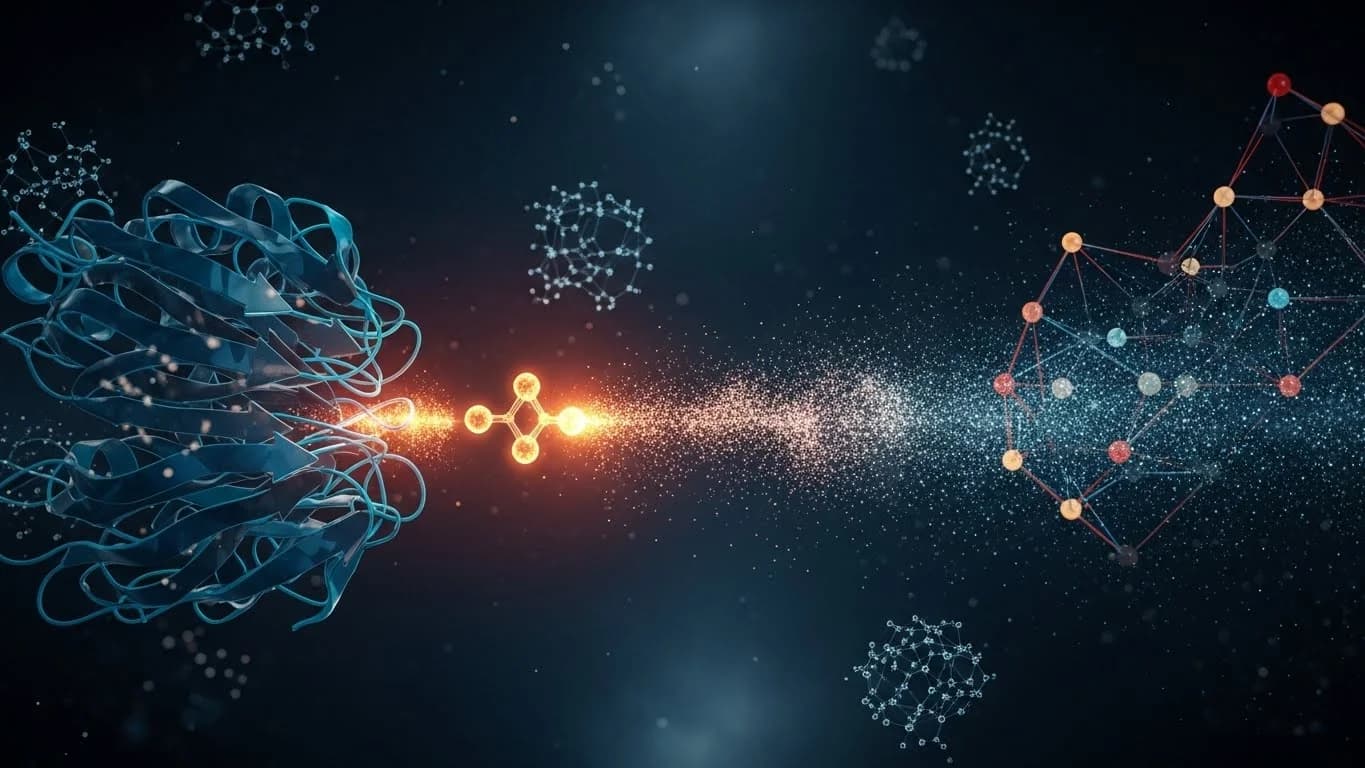
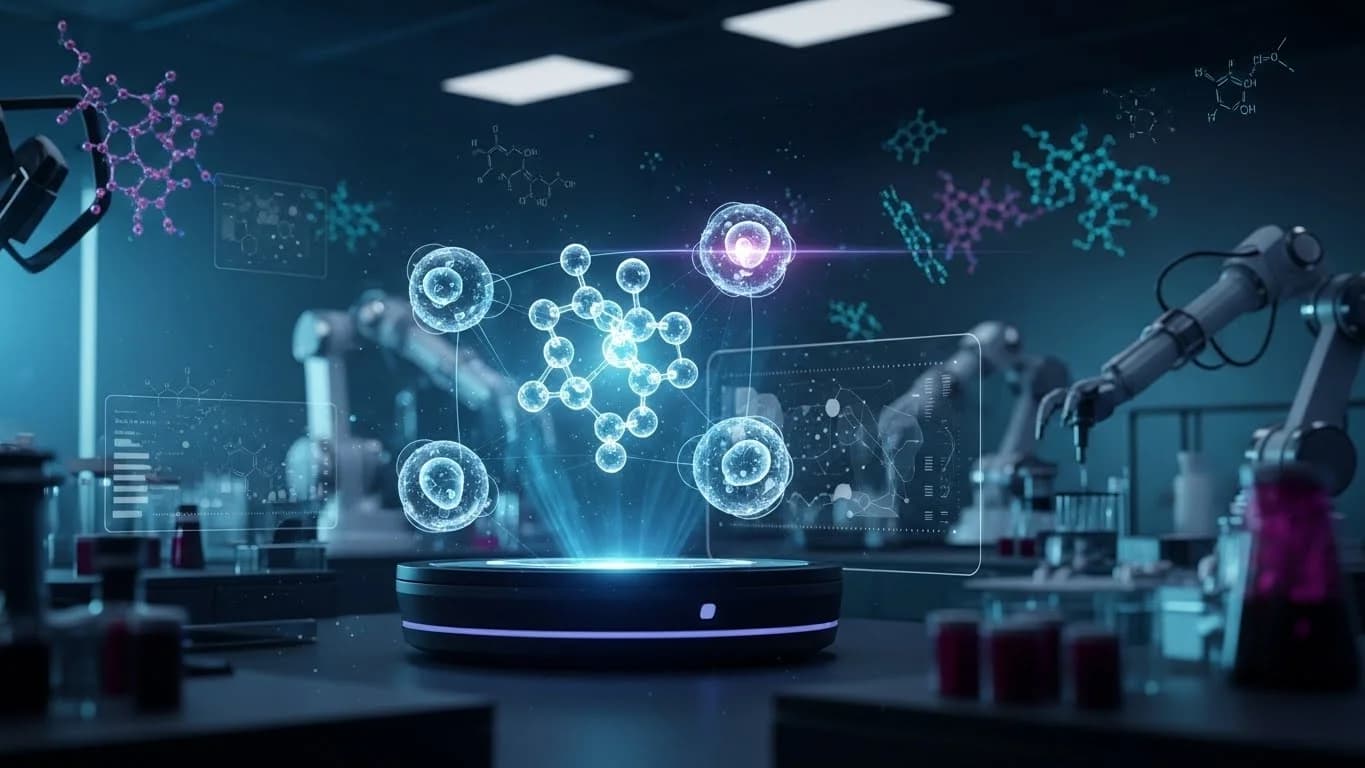
The Language of Life (Part 3): The 'Digital Locksmith'—Generative AI for Small Molecule Design

Table of Contents
- The "Old Way": Brute-Force High-Throughput Screening (HTS)
- The Generative Approach: The In Silico "Digital Locksmith"
- The Real Power: Multimodal Optimization (MPO)
- Conclusion
The "Old Way": Brute-Force High-Throughput Screening (HTS)
In Part 2, we detailed how we use generative models to design novel protein targets—the "locks." Now, we turn to designing the "keys": small molecule drugs.
For decades, small molecule discovery has been dominated by High-Throughput Screening (HTS). This is a physical, brute-force process. You physically test millions of existing "keys" (compounds) from a physical library against your new "lock" (protein target) and "hope" one fits.
The limitations are obvious to anyone in medicinal chemistry:
- Slow and Expensive: A physical screen is a massive, resource-intensive undertaking
- Limited Chemical Space: You are limited to the millions of compounds you already have. The "drug-like" chemical space is estimated to be >10^60. HTS explores a minuscule fraction of this
- Random: It is pure "trial and error." Hit rates are notoriously low, often 0.1% or far lower
The Generative Approach: The In Silico "Digital Locksmith"
Our generative approach inverts this paradigm. We do not search for a key; we design and build a perfect one from scratch.
Step 1: Defining the "Lock" (The 3D Pocket)
Using our protein models (from Part 2), we precisely map the 3D target pocket. We don't just see its shape; we map its biophysical properties: hydrophobicity, charge, and the exact 3D coordinates of its hydrogen bond donors and acceptors.
Step 2: Generating the "Key" (The Molecule) Atom-by-Atom
This is the critical technical step. We do not use 1D/2D generative models (like SMILES-based RNNs) because they are "structure-agnostic." A SMILES string has no concept of the 3D pocket it needs to fit.
Instead, we use 3D-Equivariant Generative Models, specifically E(3) Equivariant Diffusion Models (EDM).
The concept of equivariance is the key. An E(3)-equivariant model respects 3D space. If you rotate the protein pocket (the "lock"), the generated molecule (the "key") rotates with it. This physical constraint is essential for de novo design.
How it Works: The model starts with a "cloud" of randomized atoms (noise) inside the 3D coordinates of the target pocket. It then "denoises" this cloud, step-by-step, jointly deciding two things for each atom: its chemical identity (Carbon, Nitrogen, Oxygen, etc.) and its precise 3D (x, y, z) coordinates. The entire process is conditioned on the 3D geometry of the pocket. It literally "grows" a molecule, atom-by-atom, to achieve perfect 3D and chemical complementarity.
The Real Power: Multimodal Optimization (MPO)
A "key" that fits perfectly but is toxic, can't cross a cell membrane, or is impossible to synthesize is useless.
In the "Old Way," a chemist finds a "hit" (a binder), and then the medicinal chemistry team spends the next 2-3 years fixing its properties (ADMET, synthesis). This is the "hit-to-lead" valley of death.
Our generative platform solves this by guiding the generation, in real-time, using a multi-objective reward function. We do not generate 1,000 molecules and then check their toxicity. The prompt to our AI is not just "fit this pocket." It is a complex, weighted function.
This is a Multi-Objective Optimization (MPO) problem. We use differentiable scoring functions and Pareto optimization to guide the generative diffusion process at each step.
Our prompt becomes:
Generate(molecule) WHERE reward =
  (w1 * Affinity_Score) +
  (w2 * ADMET_Score_Panel) +
  (w3 * Synthesizability_Score) +
  (w4 * Novelty_Score)
The components of this prompt are:
- Affinity: A score from our 3D docking model
- ADMET: A panel of predictive models, such as predicted Blood-Brain Barrier (BBB) permeability, hERG toxicity (cardiac safety), and metabolic stability
- Synthesizability: A score from a model (like SyntheMol) trained on chemical reaction databases to ensure the molecule is not a "fantasy" compound but can be made in a lab
- Novelty: A score to push the model into novel, patentable chemical space
This MPO-guided generative process is the future of medicinal chemistry. It replaces the "trial-and-error" discovery model with intelligent, goal-directed design.
Conclusion
This "locksmith" logic applies to more than just small molecules. The same principles of 3D-conditioned generation and multi-objective optimization are how we are designing the next generation of medicine: antibodies. We will cover this in Part 4.
#smallMolecule #drugDiscovery #E3equivariant #medicinalChemistry #MPO