The Language of Life (Part 7): Generative Biology is Here—How to Start Your First In Silico Design Program
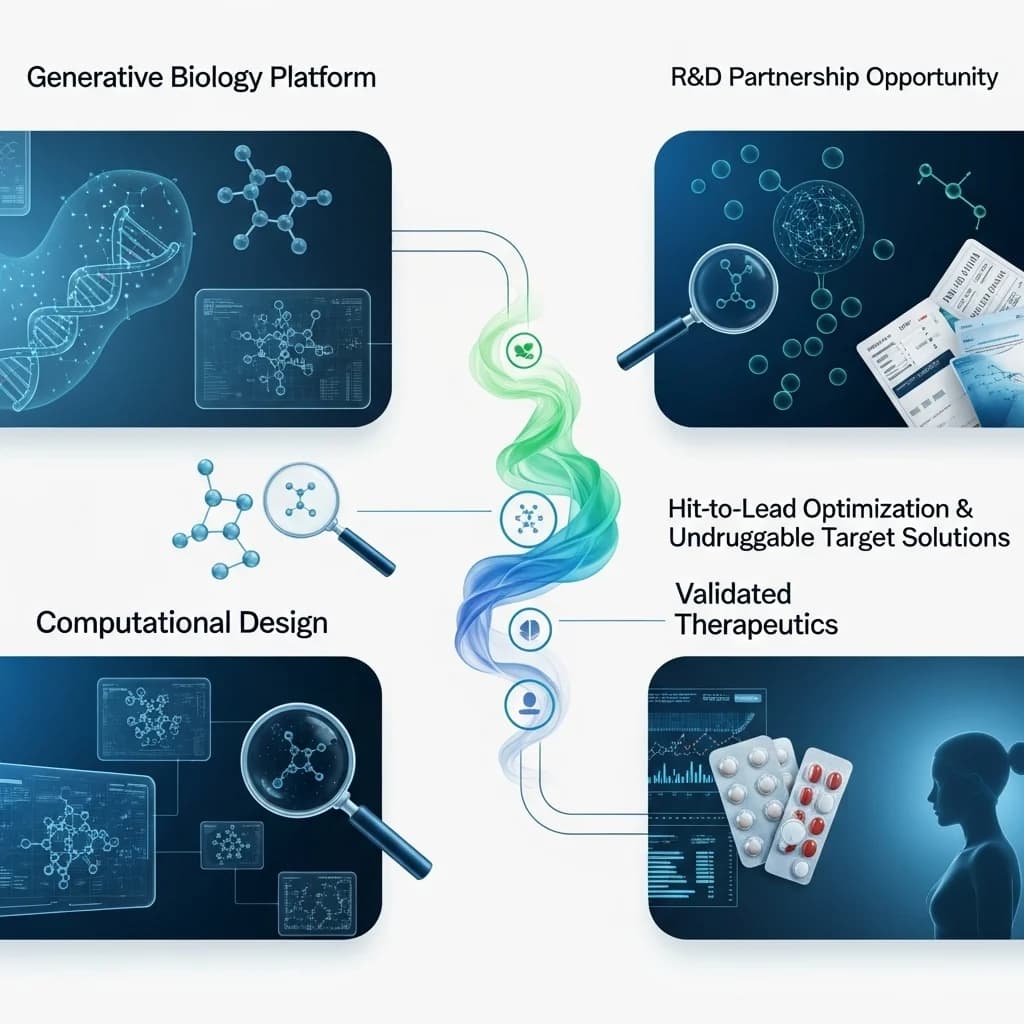
Table of Contents
- The New R&D Standard is Here
- Partner, Don't Build: The Platform is the Product
- Two Tangible "First Project" Offerings
- Your Call to Action
- Related Series
The New R&D Standard is Here
We have spent the last six posts on a technical deep dive into the Humanome.ai platform. We have shown you how our Generative AI:
- Speaks the language of proteins by learning from 200M+ sequences (Part 1)
- Designs novel functions from scratch using 3D "constrained hallucination" (Part 2)
- Generates optimized small molecules and biologics using Multi-Objective Optimization (Parts 3 & 4)
- Validates all candidates for efficacy and toxicity in our "Virtual Lab" (Part 5)
- Learns exponentially from real-world data via a "Closed-Loop" Active Learning flywheel (Part 6)
This is no longer science fiction. The integration of AI, computational biology, and high-throughput automation is the new, validated standard for therapeutic R&D. The era of relying on chance discovery and brute-force screening is over. The era of intelligent, goal-directed design is here.
Partner, Don't Build: The Platform is the Product
Your R&D organization should not be focused on building its own "protein LLM." That is not an R&D project; it is a massive IT infrastructure project.
The value is not a single, static model. The value is the entire, integrated platform: the suite of SOTA generative models, the "virtual lab" digital twins, the automated lab robotics, and, most importantly, the proprietary data flywheel from millions of closed-loop cycles.
You do not need to build this stack. You need to partner with a validated platform that is already running.
Two Tangible "First Project" Offerings
We find that partners achieve the most immediate, high-impact results by focusing our platform on their two biggest R&D bottlenecks: "hit-to-lead" and "undruggable" targets.
First Project 1: 'Hit-to-Lead' Optimization
Your Problem: "We have a 'hit' molecule from an HTS screen, but it's a weak binder, has a poor ADMET profile, or is a synthetic nightmare". This is the "hit-to-lead" valley of death, where >90% of projects fail.
Our Solution: "Give us your 'hit' compound. Our platform (from Part 3) will use it as a starting scaffold. We will generate 1,000 de novo versions, all optimized via our MPO for simultaneous high potency, patentable novelty, low off-target toxicity, and high synthetic accessibility. We will deliver a small set of "lead-optimized candidates", validated with in-vitro data from our closed loop, in a fraction of the time."
First Project 2: 'Un-druggable' Targets
Your Problem: "We have a high-value target—like a protein-protein interface (PPI) or an intrinsically disordered protein (IDP)—that is 'undruggable' because it has no defined binding pocket".
Our Solution: "Give us your 'undruggable' target. Our de novo design platforms (from Parts 2 & 3) will design the first-ever molecules to bind it. We will use 'constrained hallucination' to design a de novo biologic (e.g., a mini-binder) that binds its disordered region. Or, we will use our 3D generative models to identify and fill a "cryptic pocket" that was invisible to traditional methods. We will deliver the "primarily hit compounds" that make the undruggable, druggable."
Your Call to Action
Do not let your R&D pipeline be limited by the random chance of HTS or the slow, iterative pace of manual medicinal chemistry.
Partner with Humanome.ai and start designing the medicines of the future.
Contact us to scope your first generative design program.
Related Series
Explore our other thought leadership series:
- The AI Playbook — Navigating global AI compliance and governance
- The AI Bias Playbook — Testing, fairness metrics, and bias mitigation
#drugDiscovery #generativeBiology #hitToLead #undruggableTargets #therapeuticDesign
← Read Previous
Continue Your Journey
Reached the end